

UDID Card Apply Online 2026 – Complete Step-by-Step Application Guide
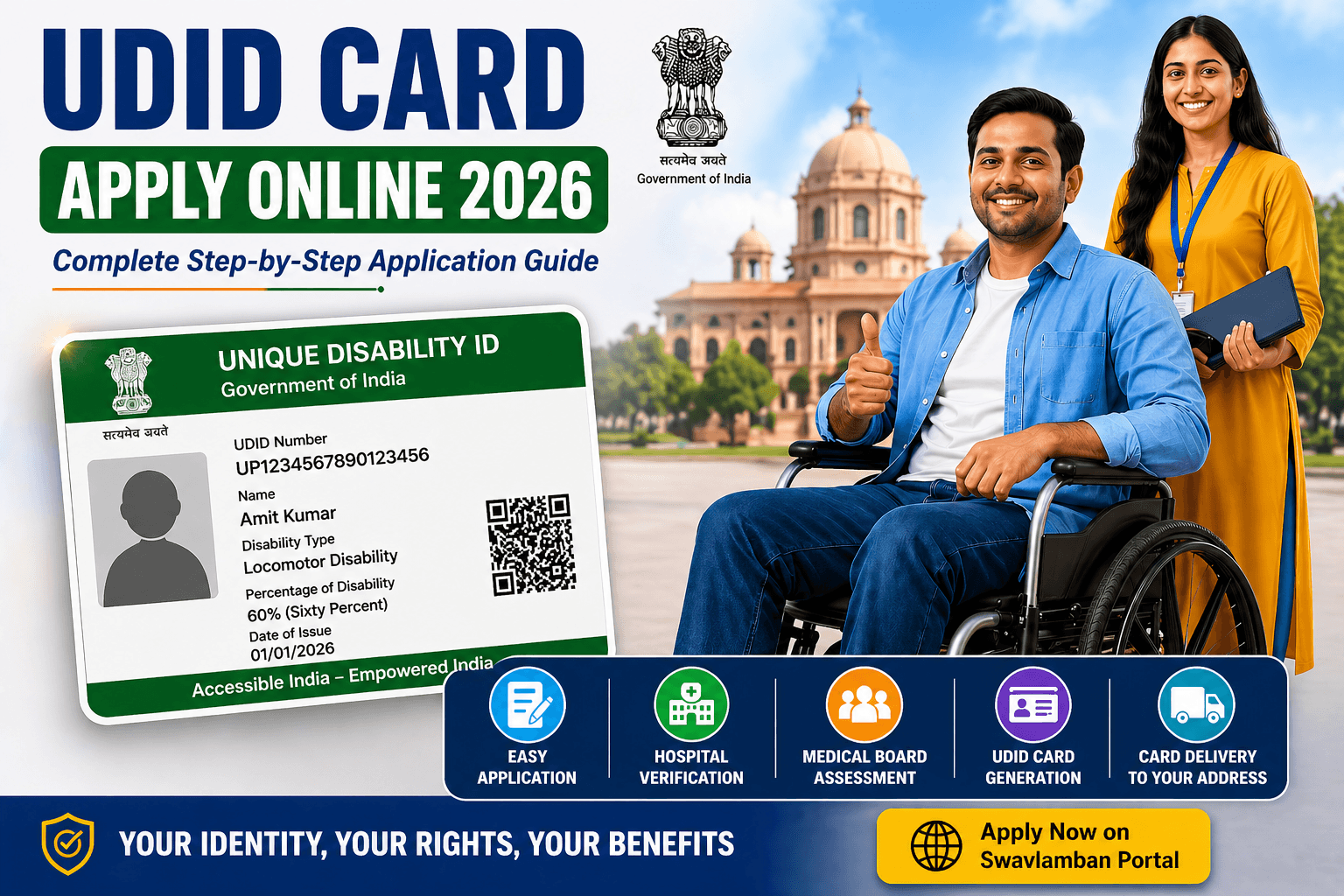
Are you worried about how to apply for a UDID card? The UDID card apply process is centralised online using the Swavlamban Card portal for PwDs. It’s a Government of India initiative designed to create a single, national database to facilitate access to government benefits and schemes.
It is managed by the DEPwD (Department of Empowerment of Persons with Disabilities). This initiative replaces multiple, cumbersome physical certificates with a single, universally accepted smart card.
Steps to Get Your UDID Card and Disability Certificate
Beneficiaries can follow these steps to get their unique disability ID card or disability certificate. You can apply either online or offline. The UDID card ensures a unique identity for persons with disabilities (PwD) and provides access to benefits.
Step 1: Submit Your Application:
Here’s a list:
1. Recent Colour Photo
2. Thumb Impression or Signature (Optional)
3. Address Proof (Aadhaar preferred, 10-500 KB, pdf/jpeg/jpg/png)
4. Identity Proof (Anyone)
5. Income Certificate
6. Caste Certificate (Only if applicable)
7. Medical Proofs or Diagnostic Records
Pro Tip: Not all the new UDID card apply documents are required for everyone. Some may vary depending on your age, type of disability, or benefit applied for.

Step 2: Visit the Hospital/CMO Office:
Step 3: Verification of Application:
Step 4: Assessment by Specialist Doctors:
Step 5: Review by Medical Board
Step 6: UDID Card Generation and Dispatch
Eligibility Criteria for Applying for a Disability Certificate in India
To qualify everyone who meets the requirements of the Rights of Persons with Disabilities Act of 2016.
21 types of recognised disabilities include:
- Blindness: Complete lack of vision. (Minimum 40%)
- Low Vision: Partial visual impairment even after treatment or correction. (Minimum 40%).
- Dwarfism: Adult height is less than 4 feet 10 inches. (Minimum 40%)
- Intellectual Disability: Below-average intellectual functioning. (Minimum 40%)
- Mental Illness: Disorders affecting emotion, thinking, or behaviour. (Minimum 40%)
- Autism Spectrum Disorder: A developmental disorder affecting behaviour and communication. (Minimum 40%)
- Cerebral Palsy: A motor condition affecting posture and movement. (Minimum 40%).
- Muscular Dystrophy: A Lot of diseases cause progressive weakness. (Minimum 40%)
- Leprosy-Cured Person: Individuals healed of leprosy but still with remaining disabilities. (Minimum 40%)
- Hearing Impairment: Half or complete hearing loss. (Minimum 40%)
- Locomotor Disability: Impairment in movement due to joints, muscles, or bones. (Minimum 40%)
- Chronic Neurological Conditions: Terms like “multiple sclerosis” and “Parkinson’s disease.” (Minimum 40%)
- Multiple Disabilities: a group of two or more disabilities listed here. (Minimum 40%)
- Acid Attack Victim: Victims of acid attacks with disfigurement or other lasting effects. (Minimum 40%).
- Specific Learning Disabilities: Issues like dyslexia, dysgraphia, etc. (Minimum 40%)
- Speech and Language Disability: A problem in speaking or communicating. (Minimum 40%)
- Thalassemia: An inherited blood disorder affecting hemoglobin production. (Minimum 40%)
- Hemophilia: A condition where blood doesn’t clot properly. (Minimum 40%)
- Sickle Cell Disease: A genetic blood disorder causing anemia and pain. (Minimum 40%)
- Parkinson’s Disease: A neurological condition that affects movement. (Minimum 40%)
- Hard of Hearing: Mild-to-moderate hearing loss, less than total deafness. (Minimum 40%
Pro Tip: The portal allows a one-time update of name, date of birth, and Aadhaar details in case of errors, so fill it out carefully.
Common Mistakes to Avoid While Applying for a UDID Card
Avoid these common mistakes for a smooth handicapped UDID card application process. Some other critical errors include wrong filing for temporary disabilities, failing to track the application process for later assessment, and not visiting an authorized government hospital.
Pro Tip: A single mobile number can be used for up to only four applications. If you are facing any issues, then contact us using the official helpline numbers.
How to Apply for a Lost UDID Card Online
If your UDID disability ID card is lost or stolen, you can apply for a duplicate card through the official Swavlamban portal. To follow the steps, help persons with disabilities quickly recover their cards.
Step-by-Step Process to Reapply for a Lost UDID Card
Follow these steps carefully to apply for a UDID card:
- Go to the official UDID portal.
- Click on “Apply for Lost UDID Card” after logging in through the PWD Login dashboard
- Enter your personal details
- UDID card Number
- Registered Mobile Number
- Enrollment Number
- Aadhaar Number
- Verify your identity using your date of birth.
- Once logged in, go to the dashboard and click on the “Lost Card” option
- Provide the reason for card loss.
- Upload the required documents.
- Complete the OTP verification and submit the request
Pro Tip: In many cases, uploading an FIR (First Information Report) is compulsory when applying for a lost UDID card.
Conclusion:
UDID card apply is an easy process through the official Swavlamban portal. The applicant may apply for a lost udid card online in just a few simple steps. It may have 21 types of disabilities that can be eligible for the UDID card.
By carefully sending the required details in all fields, submitting accurate documents, and avoiding common mistakes, for smooth approval process. The government has also implemented a straightforward online reapplication process to recover a lost UDID card and renew a disability card.
